You spend ten minutes helping a customer choose a mixer. They ask for a discount. You agree. They scan your QR code, pay ₹10,000, and leave with the box.
You expected to have ₹800 left after paying your supplier. With 0.4% MDR, you have ₹760. The fee is ₹40. Small enough to disappear inside a ₹10,000 bill. Large enough to take 5% of what you expected to keep, before you have paid rent or salaries.
Now imagine that happening through the month. You start looking at discounts differently. Your customer, meanwhile, has heard that UPI is still free. Both of you have a point. To understand why, let’s follow that sale from your counter to your closing accounts.
Rates checked on 18 September 2026, against the Ministry of Finance’s 15 September announcement.
What MDR takes from your sale
Let’s call our example shop Saanvi Home Appliances. You sell mixers, kettles, and larger appliances. You accept ordinary UPI payments from customers’ bank accounts, and your shop falls outside the small-merchant exemption.
The ₹40 deduction has a name: Merchant Discount Rate, or MDR. It is the processing fee a merchant pays to accept a qualifying digital payment. You do not need to remember the full name to understand the effect. Your customer pays ₹10,000. After ₹40 of MDR, ₹9,960 remains for your shop.
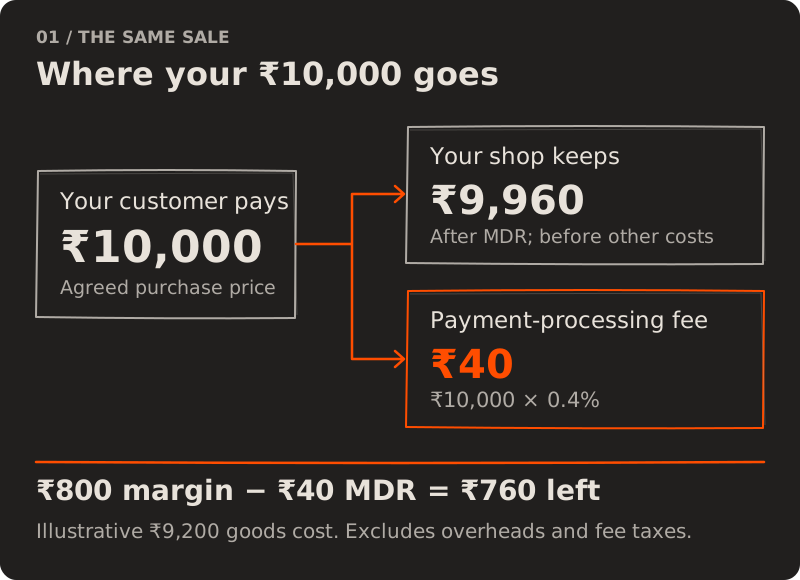
That ₹9,960 still has work to do. Your supplier needs ₹9,200 for the mixer. You are left with ₹760 to help cover the shop’s expenses and, eventually, your profit. Here is the part that catches people out: MDR is calculated on the whole sale. The payment provider does not first ask how much you earned from it.
In our example: the selling price and supplier cost are illustrative. We show MDR on its own, before overheads, any tax on the fee, or other service charges.
So the fee is easy to calculate. Deciding whether you owe it takes one more step.
Which UPI payments stay free?
A few minutes later, someone buys a kettle for ₹1,800. They scan the same QR code. This payment stays within the free threshold. The shop and app are the same; the bill amount has changed.
Under the announced framework, merchant payments up to and including ₹2,000 remain free of MDR. The general 0.4% rate concerns eligible merchant payments above that amount. That is why the mixer and kettle get different treatment. And some payments stay free even when the amount is larger:
| What you are paying for | MDR treatment |
|---|---|
| Sending money to another person | Free, regardless of amount |
| Paying a merchant up to ₹2,000 | Free |
| Paying a protected small QR merchant | Free under the P2PM exemption |
| An eligible merchant purchase above ₹2,000 | The merchant’s category determines the rate |
The small-merchant exemption covers QR receipts of up to ₹1 lakh a month under the P2PM category. These protections come from the September announcement.
The short names: P2P means person to person. P2M means person to merchant. P2PM is the small-merchant category used for this QR exemption.
If you sell mostly tea, snacks, or low-priced goods, many of your receipts may stay free. If you sell furniture or appliances, more of your bills may cross ₹2,000. You need to look at what customers actually pay you.
Before counting the cost, confirm your merchant category with your bank. The ₹1 lakh test concerns monthly QR receipts under P2PM; it is not a general exemption for every business that calls itself small.
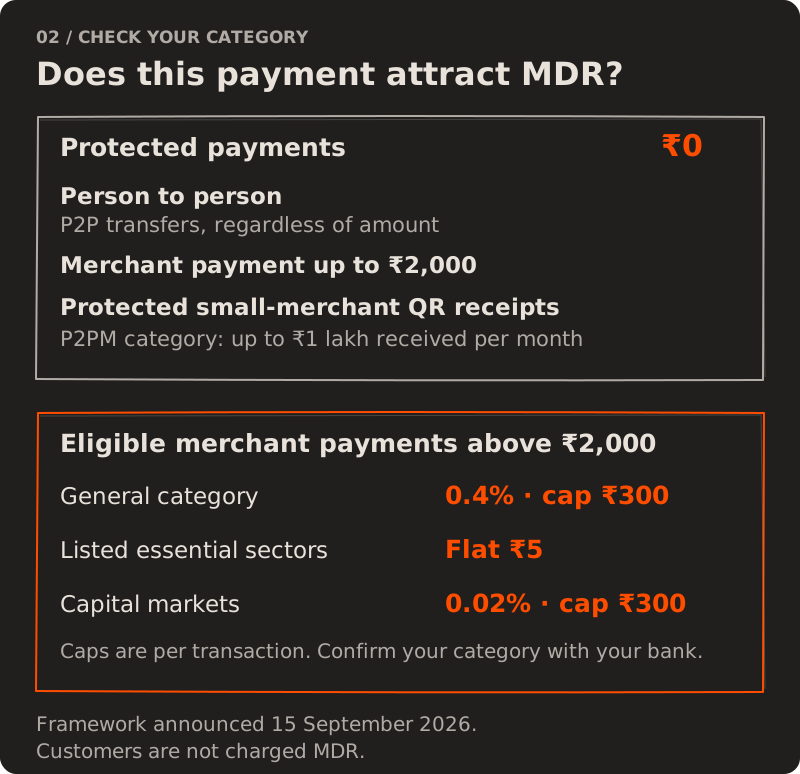
Our example shop is outside that exemption. Its mixer sale attracts MDR. Now suppose the next customer buys something much more expensive.
UPI MDR rates and the ₹300 cap
You sell ₹50,000 worth of appliances. At 0.4%, the MDR comes to ₹200. Then you take a ₹1 lakh order. Multiplying by 0.4% gives ₹400, but the general rate has a ₹300 cap per transaction. Your MDR stops there.
| General-category payment | MDR |
|---|---|
| ₹2,000 | ₹0 |
| ₹10,000 | ₹40 |
| ₹50,000 | ₹200 |
| ₹75,000 | ₹300 |
| ₹1,00,000 | ₹300 |
The cap starts helping at ₹75,000. Below that point, an eligible payment costs 0.4%. Above it, the charge stays at ₹300.
There is an easy mistake to avoid here. ₹2,000 is the free-payment threshold. Once a payment is chargeable, you calculate the percentage on its full value. You do not subtract ₹2,000 first. This is a per-transaction cap, so it does not limit your shop’s total monthly MDR to ₹300.
Lower rates for specific sectors
Our appliance shop uses the general rate. Other categories have a different schedule, including a flat fee for certain essential services.
| Eligible payments above ₹2,000 | Rate | On a ₹10,000 payment | MDR cap |
|---|---|---|---|
| General merchant category | 0.4% | ₹40 | ₹300 |
| Railways, telecom, insurance, fuel, agricultural inputs | Flat ₹5 | ₹5 | ₹5 |
| Capital markets: mutual funds, securities, stockbrokers and dealers | 0.02% | ₹2 | ₹300 |
These are the announced UPI MDR rates. The lower categories depend on how your business is classified. Having a thin margin alone does not make an appliance shop eligible for the ₹5 rate.
For you, the value of a cap or a lower rate is straightforward: you can see the cost before accepting a large order. But even a predictable fee needs somewhere to come from.
Why a 0.4% fee can take 20% of your margin
Return to the mixer. We assumed you had ₹800 left after paying the supplier. The ₹40 MDR used 5% of that amount. What if you had discounted more heavily and had only ₹200 left? The same fee would take one-fifth of your margin.
| On the same ₹10,000 sale | Margin before MDR | ₹40 takes this share | Left after MDR |
|---|---|---|---|
| A tight 2% margin | ₹200 | 20% | ₹160 |
| A 5% margin | ₹500 | 8% | ₹460 |
| Our 8% example | ₹800 | 5% | ₹760 |
| A wider 15% margin | ₹1,500 | About 2.7% | ₹1,460 |
These illustrative margins explain why one merchant may barely notice the fee while another worries about it on every bill.
You can see the same effect in a month’s accounts. Make 120 qualifying ₹10,000 sales, and your MDR adds up to ₹4,800. At our assumed 8% margin, ₹96,000 before payment costs becomes ₹91,200 before overheads.
You still have the same rent to pay. Your staff still need their salaries. The fee has reduced what is available for those bills. That is when the question moves from your accounts to your pricing: how long can you keep absorbing it?
Will customers feel it in the price?
Think back to the discount at the start. You agreed because the sale still left enough money for your business. The next time someone asks, you might hesitate. You could accept a smaller margin, negotiate with your supplier, or offer a smaller discount. If costs keep rising, you might review your regular prices as well.
That is how customers can feel a merchant’s costs without seeing a separate fee on the receipt. It is a possible response, not a certainty. If the shop next door sells the same mixer for less, you may have little room to raise your price.
The actual payment rule is clearer: customers must not be charged MDR. Banks have been told to prevent merchants passing it on, and UPI apps cannot introduce platform or hidden charges under the announced protection.
So “your UPI payment is free” can be true while “this adds pressure to the shop’s prices” is also true. One describes the charge on the payment. The other describes how a business responds to an expense. This pressure is also a good way to understand why the government removed MDR in the first place.
Why the government removed MDR in 2020
Think back to a time when most people paid you in cash. A QR code offered something useful: customers could pay without carrying the right amount, and you could stop hunting for change. But if accepting that payment meant losing a slice of each sale, you had a reason to hesitate.
The government removed that hesitation from 1 January 2020, making MDR zero for prescribed BHIM-UPI and RuPay debit-card payments. The aim was to encourage digital transactions. For your shop, the offer was simple: accept these payments and keep the sale amount without an MDR deduction. The RBI records that earlier policy here.
Once more shops put up a QR code, customers had more places to use UPI. Paying by phone became useful beyond the occasional purchase. This supported the wider Digital India initiative: merchants had a reason to accept digital payments, and customers had a reason to keep using them.
The service behind those payments still cost money. For FY 2024–25, the government approved a ₹1,500 crore incentive scheme for eligible low-value UPI merchant payments. It included a 0.15% incentive, with part of the payout linked to reliability. Public funding helped support the payment providers while merchants paid no MDR on those payments.
The new framework now asks selected larger merchant payments to contribute. For our shop, that brings the cost back to the counter as ₹40 on the mixer sale. If you are helping fund the service, it is fair to ask what that money should improve.
What should your MDR pay for?
Picture the less comfortable version of our sale. Your customer says the money has left their account. Your phone has no confirmation. They want to leave with the mixer. You do not want to hand it over without being paid. For those few minutes, payment infrastructure becomes your problem.
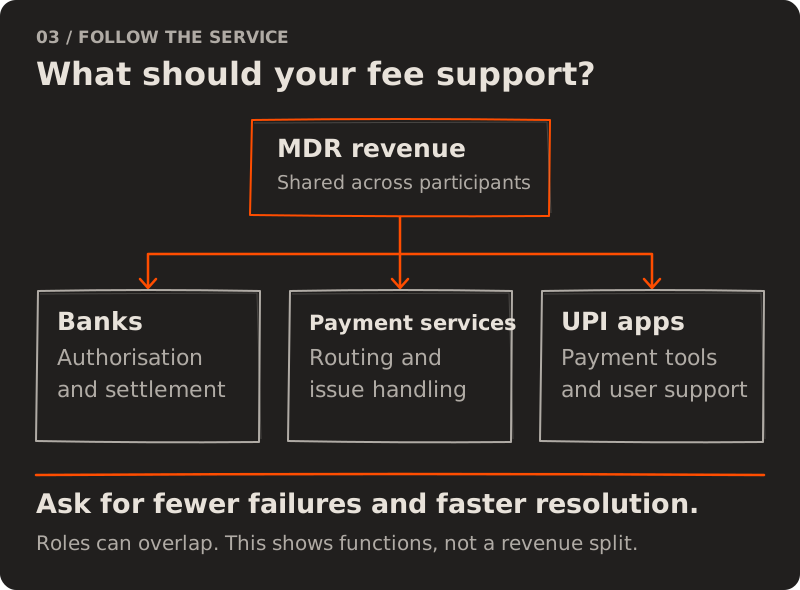
Keeping that situation rare takes work. Banks must check and move the money. Systems must record what happened. Support teams need to trace failures and help resolve them. Engineers have to keep the service available when millions of people are paying at once.
The scale is real. NPCI recorded 24.51 billion UPI transactions in August 2026, with 752 banks live on the system. Its monthly figures show how widely we now rely on it.
Research matters too. Better fraud detection can protect your money. Better recovery can shorten the wait when a payment gets stuck. Easier interfaces can help people who struggle with the current apps. I can see the case for paying for that work. As a merchant, I would also want to see the results.
Does a bigger payment cost more to process?
A ₹50,000 payment costs our shop ₹200 in general MDR. The ₹10,000 mixer costs ₹40. Does processing the bigger payment take five times as much work? The amount alone does not establish that. Some costs are fixed, some depend on transaction count, and some risks can increase with value. That leaves room for a fair challenge: show us how the price relates to the service.
The announcement does not give an audited cost breakdown proving that 0.4% is the right number. We should support funding for security and research while still asking what it costs and what improves.
For our shop, the useful improvements would be visible: fewer missing confirmations, faster answers when money is stuck, and settlement records we can understand. Those are easier to defend than an unexplained appeal to “infrastructure costs.” Still, ₹40 needs some perspective. You may already pay more when that same customer pulls out a card.
UPI vs debit and credit card charges
Suppose your customer chooses a credit card instead of UPI. With an illustrative 2% credit-card MDR, the processing fee would be ₹200. That leaves ₹600 of our original ₹800 margin before overheads, compared with ₹760 after the example UPI fee.
HDFC Bank uses this 2% example for a ₹10,000 purchase. It is an illustration, not a universal credit-card rate or a quote for your shop. Debit cards have their own caps. Here is how the same sale compares:
| Payment route | MDR rate | Fee on ₹10,000 | Per-payment cap |
|---|---|---|---|
| General chargeable UPI | 0.4% | ₹40 | ₹300 |
| Applicable debit card: small merchant, POS or online | Up to 0.4% | Up to ₹40 | ₹200 |
| Applicable debit card: small merchant, card QR | Up to 0.3% | Up to ₹30 | ₹200 |
| Applicable debit card: other merchant, POS or online | Up to 0.9% | Up to ₹90 | ₹1,000 |
| Applicable debit card: other merchant, card QR | Up to 0.8% | Up to ₹80 | ₹1,000 |
| Credit card, using the 2% example | 2% | ₹200 | Check your agreement |
The debit-card figures are ceilings from the RBI’s December 2017 schedule. Your contracted rate can be lower.
For this comparison: “small merchant” in the debit-card schedule means previous-year turnover up to ₹20 lakh. “Card QR” means debit-card QR acceptance. RuPay debit cards were covered by the separate zero-MDR policy from 2020.
This is why credit card MDR in India and debit card transaction charges cannot be reduced to one number. Your card type, business category, and provider agreement all matter. A credit card also funds a purchase through credit, which brings different costs from paying out of a bank balance.
For our shop, the ₹40 UPI fee compares favourably with the illustrative ₹200 card fee. But a lower bill does not end the conversation about who gets paid.
Who earns from UPI: banks, apps, and their owners
There is an obvious irony here. We celebrate having an alternative to Visa and Mastercard, then find American-linked app companies among the businesses that can earn from UPI. Apparently, the QR code did not remove the debate about foreign ownership. It gave us a new version of it.
Google Pay is Google’s service. PhonePe is an Indian business whose 2026 draft prospectus lists Walmart Inc. in the US as its ultimate holding company. The concern about where the financial benefits go is fair.
But look at what happens at your counter. A customer can use one UPI app to pay your shop even if you use another. The shared system makes that possible. NPCI describes this open, interoperable structure in its UPI paper.
Interoperable means different apps and banks can work together. You and your customer do not have to use the same provider.
That gives India more control over how everyday payments work. It does not mean every company using the system has Indian owners, or that every rupee of revenue stays with one participant.
Your ₹40 is also not automatically ₹40 of app profit. The framework names banks, payment service providers, and apps as recipients. They have operating costs, and the announcement does not tell us the payout to each company. It also links 5% of MDR collections to a small-merchant adoption fund. That money, too, should produce something we can see.
The concern I would keep is this: if merchants help fund the system, do they gain better service and meaningful choice? Can smaller providers compete? Can you change providers without making payment harder for your customers? Those questions get us further than treating every foreign fee as theft or every domestic fee as fair. The ownership deserves scrutiny. So do the price and the service.
What to check in your own shop
You have sold the mixer. The customer is home. Now you are checking the day’s receipts. Some payments were below ₹2,000. Some were larger. One customer may have returned an item. Your total UPI sales alone will not tell you the correct MDR bill.
Start with the category your provider has assigned to your shop. Then match each chargeable payment to its fee and settlement. Ask how refunds are handled. If a deduction does not make sense, you have a specific transaction to discuss.
You should also be able to explain the effect in your own numbers. In our example, ₹40 takes the margin from ₹800 to ₹760. Over 120 similar sales, it becomes ₹4,800. That is the figure you need when reviewing discounts and expenses.
Your customer should be able to pay the agreed price without an extra MDR demand. You should be able to accept that payment knowing what it will cost. And when the payment goes wrong, the companies earning from it should help put it right. If ₹40 comes out of your sale, you deserve to know what you are paying for.
A few practical details
When does your provider apply it? The 15 September release does not give a separate rollout date or explain how crossing the P2PM monthly threshold is handled. Your acquiring bank—the bank that enables your merchant payments—should confirm both.
Does ₹300 cover every charge? It caps the stated MDR per eligible transaction. Equipment, optional services, and any applicable tax on fees need their own lines in your provider agreement.
Why do older articles show different rates? NPCI announced 0.30% with a ₹100 cap in August 2019 for implementation that October. The January 2020 zero-MDR policy followed. Check the date when looking up MDR charges and RBI payment systems policy.
What about wallet or credit-card payments through UPI? The funding source matters. Interchange is a fee between payment participants; it is not the same as the full merchant charge. NPCI’s 2023 wallet clarification covered wallet interchange under the rules at that time. Our shop example uses an ordinary bank-account payment.